231 Terms and Concepts listed. 177 Authors and Thinkers mentioned. 161 examples listed, 35 of them with images. 95 methods discussed.
El libro
Symbiotic Design Framework
Rethinking Design from within · A book by Dr. Gonzalo Raineri
A systemic approach to destroy Design’s actual model and build a better world in the meantime.



All versions have the same content.
We only provide print on demand, no stock, no additional pollution.
The book is only available here and it will not be distributed on other platforms.
Ask your local bookstore, your community or University library for the book with the provided ISBN numbers. Tell them here is the only place the book is available. That is the most sustainable solution, a shared book.
Is contemporary design failing us?
In an era defined by cascading crises, from ecological collapse to profound social inequality, prevailing design paradigms often feel inadequate, complicit in the very systems driving unsustainability. Dr. Gonzalo Raineri Bernain's Symbiotic Design Framework offers a radical, theoretically robust alternative for academics, researchers, and advanced practitioners seeking to fundamentally reorient the discipline.
This seminal work introduces a groundbreaking proposition: Design as an autopoietic (self-creating) social system. Drawing rigorously from systems biology (Maturana, Varela), cybernetics, and sociology (Luhmann), Raineri argues that design sustains and evolves itself through its own internal operations. Understanding this self-producing nature is crucial for intervening effectively.
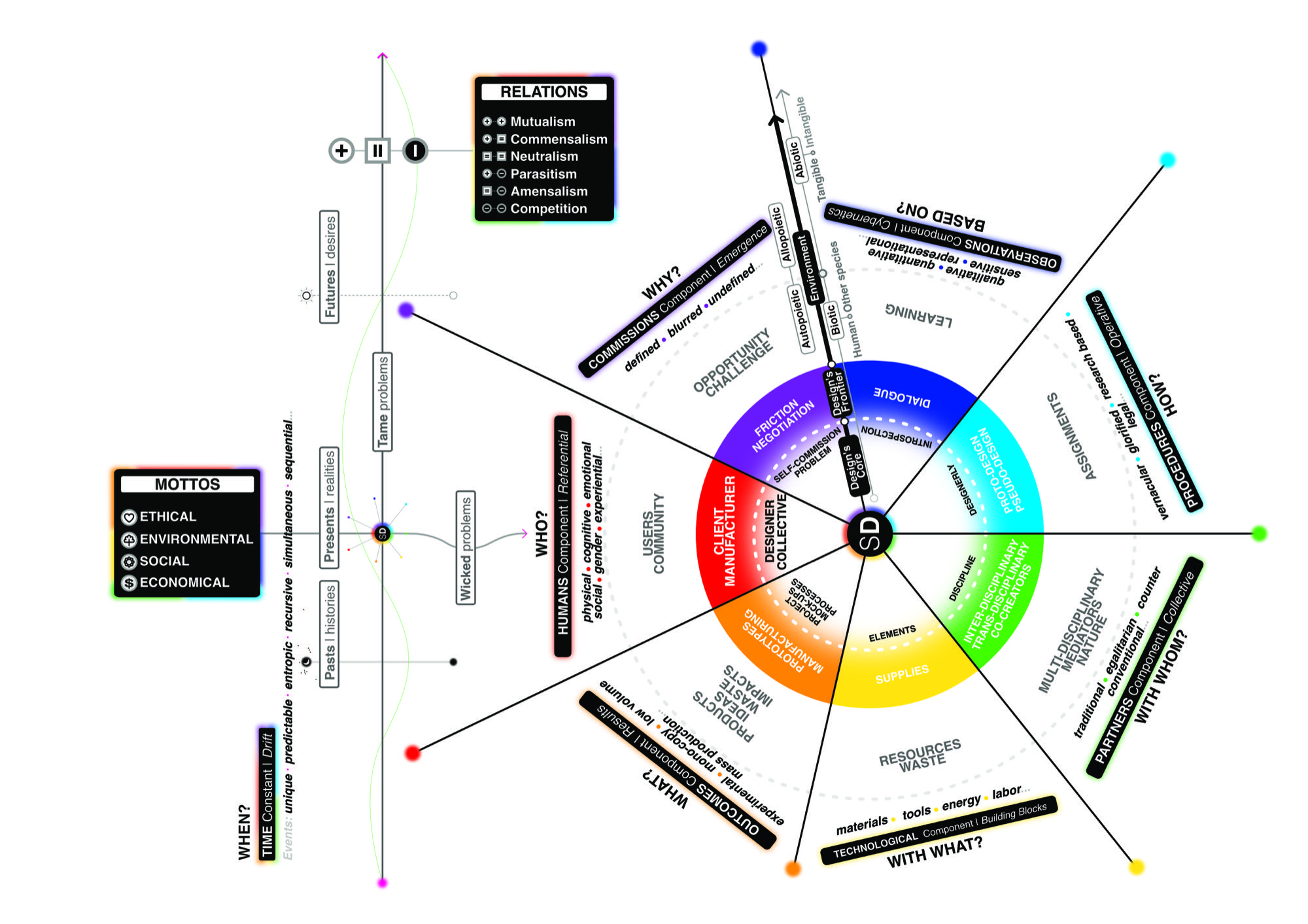
The framework provides a powerful diagnostic and strategic lens built on the biological concept of symbiosis. It moves beyond analyzing isolated components to evaluating the relationships between them. Are they mutualistic, parasitic, commensal? This relational analysis is guided by the framework's non-negotiable ethical core: the "Four Mottos":
- Ethics: The foundational pursuit of collective flourishing (Eudaimonia) and justice for all beings, informed by pluriversal perspectives.
- Sustainability: An ethical obligation for intergenerational and inter-species equity, demanding regenerative practices.
- Social Responsibility: An active commitment to equity, dignity, challenging systemic injustice, and collective liberation.
- Economics: Reframed as an ethical pursuit of shared prosperity and fundamental needs fulfillment, rejecting purely extractive models.
Key conceptual tools include:
- Seven Interdependent Components: Humans (Who?), Commissions (Why?), Observations (Based on What?), Procedures (How?), Partners (With Whom?), Technology (With What?), Outcomes (What?).
- Three Operational Dimensions: Mapping activity across the self-producing Core, the interactive Frontier, and the contextual Environment.
- Tame vs. Wicked Problems Distinction: A critical diagnostic for navigating complexity.
- Engagement with Time: Understanding design's operation within past legacies, present flux, and future responsibilities.
The Symbiotic Design Framework challenges practitioners to move beyond designing mere objects or optimizing flawed systems. It demands a shift towards stewarding living relationships over time, consciously engaging with design as an inherently political act, and actively countering the extractive logics of the Capitalocene. It is a call to embrace complexity, pluriversality, and ethical courage.
Intended for design theorists, doctoral researchers, educators, and high-level practitioners, this book also offers invaluable insights for professionals in systems thinking, sustainability, social innovation, policy, and any field grappling with wicked problems and seeking transformative, ethically grounded approaches. It is not another methodology; it is a fundamental recalibration of the design discipline itself.
- 231 Terms and Concepts listed.
- 177 Authors and Thinkers mentioned.
- 161 examples listed, 35 of them with images.
Content
Forging the Foundation
Chapters
Chapter [01] Confronting Our Moment
We must confront the inescapable reality of when we are. It is a moment defined not by a vague "Anthropos," but by the Capitalocene, a specific economic logic built on "Cheap Nature" and fueling extreme carbon inequality, where the richest 1% emit as much as the poorest 5 billion people. We are mired in interconnected "wicked problems" , leaving us at a crossroads: will design remain complicit in this destruction, or will it finally become a force for healing?
- [001] Where Do We Stand in Time?
- [002] Finding Our Footing in the 'Now'
- [003] The Weight and Wisdom of the Past
- [004] The Heart of the Matter: Emotion, Choice, and Why We Design
- [005] Breaking Free: The Hard Work of Questioning Dogma
- [006] Stepping Towards a Symbiotic Future
- [007] Confronting the Anthropocene and Assuming the Capitalocene
- [008] Wrestling with Wickedness: The Tangled Knots of Now
- [009] Flickers of Awakening: Have We Learned the Lessons?
- [010] The Designer's Crossroads: Complicity or Transformation?
- [011] Beyond Techniques: A Shift in What We Value
Illuminating the Theory
Chapters
Chapter [05] A Journey into Systems Theory
The recent surge in systems thinking is not an invention, but a re-discovery of ancient, intuitive wisdom. This holistic grasp of interconnectedness echoes in Greek philosophy , in the Buddhist concept of pratītyasamutpāda (dependent origination) , and in the Taoist alignment with natural flow. The 9th-century Borobudur temple stands as a profound masterpiece of systemic design , a 3D mandala guiding a transformative spiritual experience. This ancient wisdom was later formalized in the West through General Systems Theory (von Bertalanffy) and Cybernetics (Wiener) , leading us to the crucial "biological turn": Autopoiesis.
- [042] Unearthing the Systemic Roots
- [043] Echoes of Systemic Thought in Antiquity
- [044] Borobudur as a Systemic Masterpiece
- [045] The Emergence of Formal Systems Thinking
- [046] Pioneers of Systemic Application in Design
- [047] The Biological Turn Towards Autopoiesis
Articulating the Framework
Chapters
Chapter [08] The Emergence of the Framework
This framework was not invented in isolation; it gradually emerged through a journey spanning theory, immersive observation, and global dialogue. It began by wrestling with the elusive nature of "design" and "sustainability" , a path that led inexorably to biology and the transformative concept of Autopoiesis. My doctoral research confirmed the hypothesis: design itself operates as a dynamic, self-producing autopoietic system. This theoretical core was then stress-tested in the "living laboratory" of the World Design Capital® Valencia 2022. Finally, it was forged through collaborative dialogue, which integrated the Four Mottos and revealed Time as a fundamental, enveloping constant.
- [086] A Journey Through Inquiry, Observation, and Dialogue
- [087) Design as an Epistemological Object
- [088] The Methodological Journey
- [089] Questioning Design's Foundations
- [090] The Turn to Biology: Discovering Autopoiesis
- [091] The Doctoral Deep Dive
- [092] From Theory to the World Stage Validation in Valencia
- [093] Collaborative Refinement
Components
Chapters
Chapter [10] Humans Component
We must affirm that the Human Component is the absolute cornerstone of design, the referential sine qua non asking "Who?". Design is not an abstract mechanism but an intrinsically human act , rooted in our unique agency for intentional creation, or heteropoiesis. This component is the very locus where the Four Mottos are enacted through human ethical reasoning. We must analyze this "Who?" across its dimensions: the Core (the Designer and Community) , the Frontier (Clients and Manufacturers) , and the Environment (the Users and Communities impacted by our work). This requires grappling with the complex variables of human experience: Physical, Cognitive, Emotional, Social, and Gender.
- [100] Referential (Who?)
- [101] Alignment with the Four Mottos
- (102] Autopoletic Significance of the Human Component
- [103] Humans Dimensions
- [104] Core Dimension
- [105) Frontier Dimension
- [106] Environment Dimension
- [107) Variables Influencing the Human Component
- [108] The Influence of Time on the Human Component
The SDF in Action
Chapters
Chapter [17] Using the Symbiotic Design Framework
We must understand that the Symbiotic Design Framework is not a method; it is a mindset, a stance. It demands we shift our focus from isolated things to the quality of relationships unfolding over time. Anchored by Time as medium, Environment as active participant, and Symbiosis as analytic , it compels us to cultivate conditions rather than chase control. Using an adapted Bronfenbrenner hierarchy (Micro- to Exosystem) helps scale our relational analysis within the Chronosystem. Practice unfolds through Four Concurrent Events requiring constant vigilance guided by the Four Mottos. This distinguishes the internal Symbiotic Designer from the External Adopter translating the lens to other fields.
- [164] The Symbiotic Mindset
- [165] A Conceptualization of Scale and Hierarchy
- [166] A System of Four Concurrent Events
- [167] Roles in a Collaborative Ecosystems
- [168] A Foundational Distinction
- [169] The Symbiotic Designer
- [170] The External Adopter
- [171] The Collaborative Ecosystem: Essential Partners in Creation
- [172] The SDF in Education.
- [173] The SDF in Research
- [174] The Framework in Summation
All versions have the same content.
We only provide print on demand, no stock, no additional pollution.
The book is only available here and it will not be distributed on other platforms.
Ask your local bookstore, your community or University library for the book with the provided ISBN numbers. Tell them here is the only place the book is available. That is the most sustainable solution, a shared book.
Frequently asked questions
What exactly is the "Web Experience Edition"?
Unlike a static PDF or EPUB, the Web Experience Edition is a fully integrated, secure digital experience hosted exclusively on the Symbiotic Design Academy platform. It is a "Living Book" designed for immersive study, featuring audio integration and secure access to our latest research.
Can I download the book to my Kindle or iPad?
No. To maintain the integrity and security of the research, the book is read directly through our secure member portal. It cannot be exported to Kindle, Apple Books, or other third-party e-readers. You can access it on any device with a modern web browser.
Will I get future editions of the book?
Yes. While we don't push "real-time" daily updates, we are committed to the evolution of Symbiotic Design. If we release a "Revisited Edition" in the future with new chapters or expanded frameworks, owners of this Web Edition will receive that upgrade entirely for free for the time their subscription is valid (12 months).
Is there an audio version included?
Yes. Each chapter includes a AI generated Voice Option. This allows you to listen to the content as you follow along, perfect for multi-modal learning, accessibility, or learning on the go.
Can I copy text or download images?
No, just like in a printed book, you can't and should not copy texts and images. They are property of the respective authors.
If you wan't to use any portion of this book or any of the images, contact the author directly or the owners of the images. They are all properly credited in the book.
You can cite brief portions of the text in accordance to traditional academic usage and fair use.
To protect the intellectual property and unique frameworks of the Academy, text copying, highlighting, and right-clicking are disabled. Additionally, images and diagrams are protected from direct download. We encourage you to keep a personal notebook or digital journal for your reflections just as you do with a printed book.
Does my progress save?
No. But we have tagged every thing so that is easy to go back to were you left.
Can I share my account with a teammate?
No. Your purchase grants a single-user license. Our security system monitors for simultaneous logins from different geographic locations; if detected, this may trigger an automatic security lock on the account.
Why a Web Edition instead of a PDF?
The Web Edition provides a much richer experience than a static file. It allows us to integrate voice-enabled chapters and ensures that when the field of Symbiotic Design evolves, we can provide you with the updated "Revisited" version of the book seamlessly through your existing portal.